Consumer Metrics Institute
Daily Technology Index

E-Mail:
See sample Special Commentary available only to Members:

HomeHistoryAutomotiveEntertainmentFinancialHealthHouseholdHousingRecreationRetailTechnologyTravelFAQsDownloadsMembershipContactAbout


"Bringing the measurements of critical economic activities into the twenty-first century by
mining tracking data for an understanding of what American consumers were doing yesterday."


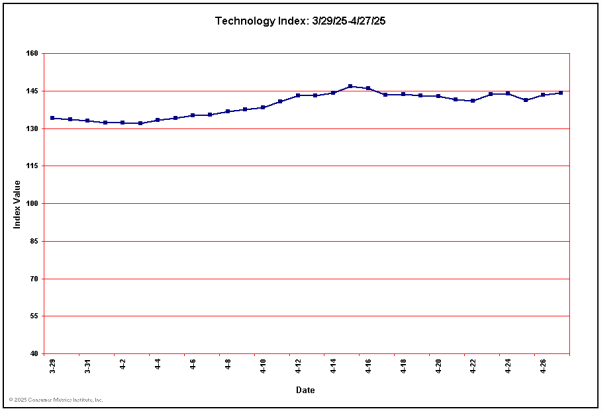
Technology Sector Leading Indicator for Past 30 Days


Last 10 Technology Index Values
Date:08/25/201008/26/201008/27/201008/28/201008/29/201008/30/201008/31/201009/01/201009/02/201009/03/2010
Value:99.0199.3499.2298.7598.2598.3498.0798.0398.3898.77

 Note: The Technology Index reflects consumer interest in all manner of consumer electronics, including computers, wireless equipment, cell phones, video games, televisions, home theaters, audio systems, personal music devices, music CDs, DVDs, cameras, and downloads of music or video content.


Commentary


 February 12, 2010 - Our 'Quarterly' Growth Index Contracts at 1.24% :

By February 12th, 2010 our trailing 91-day sliding 'quarter' Growth Index (our analog for a real-time 'GDP', but composed of Consumer-only demand) was contracting at an annualized rate of 1.24%. To provide some perspective for this measurement, a calendar quarter of equivalent U.S. GDP growth would be within the lowest 13th percentile among all GDP quarterly growth figures recorded since the spring of 1947 by the U.S. Department of Commerce's Bureau of Economic Analysis (BEA) -- i.e., less than one in seven quarters since the spring of 1947 would have been worse.

We have been asked how our measurements could differ so significantly from the BEA's most recent readings of the GDP (reported growing at a 5.7% clip). There are several reasons for the differences, all of which are significant for investors:

1) In order to maintain consistent data series, the BEA is measuring the same types of supply-side data that they first developed in the middle of the previous century in a effort to analyze economic activities that were important at that time. We, on the other hand, are using twenty-first century technologies to measure real-time demand-side consumer activities typical of today.

2) The pace of the mid-twentieth century economy was such that a quarterly update was considered adequate for largely academic pursuits. Our indexes, however, have a daily time resolution and are updated daily (within days of data acquisition) for the benefit of the investing public.

3) The BEA extensively revises their numbers over several months in order to get the numbers finally 'right'. This may have been acceptable 60 years ago, particularly when used for leisurely academic analysis. In contrast, our daily numbers are final when published.

4) There is a natural lag between changes in demand and when the impact of those changes filter down through the supply chain to factories. If Consumer demand is the fundamental stimulus of most economic activity in the U.S., we are much closer to (or further 'upstream' towards) the source of any changes in the economy.

The net result of the above differences was that the BEA's measurement of the 4th Quarter 2009 U.S. GDP lagged our trailing 'quarter' Growth Index by about 17 weeks (see left hand chart at top of page). IF the BEA's numbers continue to lag ours by about 17 weeks we can expect that:

1) On April 30th 2010 the BEA will announce an advanced estimate of the 1st Quarter 2010 U.S. GDP annualized growth rate of about 2.5% (approximating our November 30th Growth Index).

2) Similarly, on July 30th 2010 they will announce that the 2nd Quarter 2010 U.S. GDP contracted at an annualized rate of slightly over 1% (a reasonable projection of our February 28th 2010 Growth Index).

Will this mean that the 'economy' started to contract in the 2nd quarter of 2010? We know that the 'demand' side of the economy actually peaked in August of 2009, and has declined since. What the BEA will actually be determining with their 2nd Quarter GDP numbers is that the production (or 'supply' side) was finally adjusting to those 'demand' side changes six months later.

During the week ending February 12th we saw a lot of changes in the relative strength of our sector indexes. The Automotive Index, although choppy, finished the week strongly, with the Japanese, Luxury and Economy Sub-Indexes all showing substantial upward movements over the past few weeks. Similarly the Technology Index stayed positive and rebounded late in the week, primarily on continued strength in the Computers and MP3 Players Sub-Indexes. Overall, six of our ten sectors were in a growth mode, but the heavily weighted Housing Sector pulled the 'Weighted Composite Index' down to neutral territory since it was still contracting at about a 4% year-over-year rate -- which was, nevertheless, a notable improvement from the over 17% annualized contraction reading on December 26th.


 Note: A more complete list of historical Commentary can be found on our History Page ...


Technology Sector 52-Week Sub-Indexes


 52-Week Sub-Indexes Available on Members Page: 
     Computers 52-Week Sub-Index Chart 
     MP3 Players 52-Week Sub-Index Chart 
     Cameras 52-Week Sub-Index Chart 
     Gaming Consoles 52-Week Sub-Index Chart 
See sample Sector Sub-Index Charts available only to Members:


Links


HomeHistoryAutomotiveEntertainmentFinancialHealthHouseholdHousingRecreationRetailTechnologyTravelFAQsDownloadsMembershipContactAbout


Consumer Metrics Institute In The News:
Phil's Stock World (09/02/2010)
 
The Pragmatic Captialist (09/01/2010)
 
ETF Digest (08/31/2010)
 
Larry Doyle at SenseOnCents.com (08/30/2010)
 
Doug Short's DShort.com (08/30/2010)
 
Blogs For Victory (08/29/2010)
 
InvestorsInsight.com (08/29/2010)
 
The Automatic Earth (8/29/2010)
 
The Pragmatic Capitalist (8/29/2010)
 
Financial Times LEX Article (08/26/2010)
 
John Keefe at CBS Money Watch (8/26/2010)
 
The Market Financial (8/24/2010)
 
Matthew Hunt Interview at CityWire (08/24/2010)
 
Some Assembly Required (08/24/2010)
 
DailyMarkets.com (08/23/2010)
 
CapitalLogix Commentary (8/23/2010)
 
Phil's Stock World (08/23/2010)
 
The Automatic Earth (8/23/2010)
 
Doug Short at DShort.com (8/23/2010)
 
Ted Kavadas at EconomicGreenField.com (8/23/2010)
 
Larry Doyle at SenseOnCents.com (08/22/2010)
 
The Market Financial (8/22/2010)
 
AllVoices.com (8/22/2010)
 
Robert Wenzel at Economic Policy Journal (8/20/2010)
 
Jeff Harding at The Daily Capitalist (8/20/2010)
 
Phil's Stock World (8/17/2010)
 
Robert Wenzel at Economic Policy Journal (8/17/2010)
 
Doug Short at dshort.com (8/17/2010)
 
Pragmatic Capitalism PragCap.com (8/16/2010)
 
Calculated Crunch News Law (7/30/2010)
 
Mike Shedlock ("Mish") (7/30/2010)
 
Jesse's CAFÉ AMÉRICAIN (7/30/2010)
 
Phil's Stockworld (7/30/2010)
 
Doug Ross (7/30/2010)
 
Belisarius at Tainted Alpha (7/30/2010)
 
Larry Doyle of SenseOnCents.com (7/30/2010)
 
Doug Short at Seeking Alpha (7/30/2010)
 
Robert Wenzel at Economic Policy Journal (7/30/2010)
 
Dave Cohen at Decline of the Empire (7/29/2010)
 
Bill Cara at CaraCommunity.com (7/28/2010)
 
Daryl Montgomery in etfguide (7/28/2010)
 
ETF Digest (7/27/2010)
 
Jule Herbert at 'What a World!' (7/27/2010)
 
Larry Doyle at DailyMarkets.com (7/26/2010)
 
Ted Kavadas at EconomicGreenfield (7/27/2010)
 
MorningStar (7/23/2010)
 
Doug Short at DShort.com (7/19/2010)
 
The Economic Collapse Blog (7/19/2010)
 
Jeff Harding at The Daily Capitalist (7/19/2010)
 
Duncan Davidson at Planet Yelnick (7/17/2010)
 
Dick Lepre at RPM Mortgage (7/16/2010)
 
Eric Sprott at advisoranalyst.com (7/12/2010)
 
Jonathan Ratner at Financial Post (7/12/2010)
 
Mike Pienciak at the Motley Fool (7/12/2010)
 
Larry Doyle on ICSC Report (7/8/2010)
 
Jason Busch at Spend Matters (7/2/2010)
 
Lisa Reisman in AG Metal Miner (7/1/2010)
 
Larry Doyle at SenseOnCents.com (6/30/2010)
 
Zero Hedge (6/30/2010)
 
Pragmatic Capitalism PragCap.com (6/30/2010)
 
Breakawaytrading's Blog (6/29/2010)
 
"DoctoRx" at EconBlog Review (6/29/2010)
 
Mike Pienciak at Fool.com (6/11/2010)
 
Bob English at the Economic Policy Journal (6/10/2010)
 
John Mauldin at safehaven.com (6/5/2010)
 
Paul Vigna in Market Talk (6/6/2010)
 
Credit Writedowns (6/5/2010)
 
Bill Cara's Blog (6/4/2010)
 
Bob Wenzel's Economic Policy Journal (6/3/2010)
 
Chuck at Rebel Traders (6/3/2010)
 
Real Liberty Media (6/3/2010)
 
Lisa Reisman in AG Metal Miner (6/2/2010)
 
Larry Doyle in DailyMarkets.com (6/2/2010)
 
Pragmatic Capitalist (6/1/2010)
 
Amassafortune's CAPS Blog at the Motley Fool (5/30/2010)
 
Dave Fry Interview at ETF Digest (5/18/2010)
 
Gary's Biiwii.com Post (5/5/2010)
 
Jesse's Café Américain (5/4/2010)
 
Chuck's RebelTraders.net Commentary (5/2/2010)
 
Dave Cohen's Decline of the Empire (4/29/2010)
 
Evil Speculator (4/29/2010)
 
Guy Lerner's The Technical Take (4/28/2010)
 
Phil's Stock World (Full Interview with Ilene)
 
Economic Greenfield (Ted Kavadas)
 
Michael Panzer's Financial Armageddon
 
Contrarian Investor's Journal
 
AG Metal Miner (Lisa Reisman 3/22/2010)
 
Art Cashin's Morning Newsletter (via ZeroHedge)
 
Mish's Global Economic Trend Analysis (Mike Shedlock)
 
The Big Picture (Barry Ritholtz)
 
Decline and Fall of Western Civilization
 
Tim Bovee, Private Trader
 
Business Insider: Clusterstock
 
Opinion Editorial: Mark Noonan


Copyright ©2010 The Consumer Metrics Institute