Consumer Metrics InstituteDaily Retail Index |
| Home | History | Automotive | Entertainment | Financial | Health | Household | Housing | Recreation | Retail | Technology | Travel | FAQs | Downloads | Membership | Contact | About |

| Date: | 08/25/2010 | 08/26/2010 | 08/27/2010 | 08/28/2010 | 08/29/2010 | 08/30/2010 | 08/31/2010 | 09/01/2010 | 09/02/2010 | 09/03/2010 |
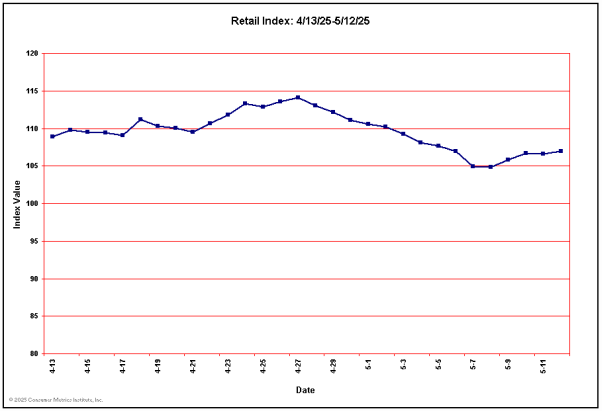
| Value: | 110.48 | 111.40 | 111.56 | 111.69 | 111.35 | 111.50 | 111.30 | 110.42 | 109.49 | 109.86 |
| Note: The Retail Index directly responds to consumer activities when seeking retail sources for durable goods. The specific types of goods to be purchased may be reflected in other categories, but this index most closely and immediately tracks imminent purchasing decisions that translate into retail sales. |
| June 24, 2010 - More Mixed Messages: Mixed messages abound when an economy is at a point of inflexion. Some economic indicators are still recording the old patterns, while other more leading indicators are starting to show the new direction that the economy is heading. At the Consumer Metrics Institute we are fortunate to have a highly unique view of the economy: we see it at the very beginning of the consumer demand cycle. From our perspective, the vast bulk of economic activity starts when a consumer (either figuratively or literally) clicks on an 'Add to Shopping Cart' button. From our vantage point, about 70% of all economic activity is an inevitable downstream consequence of the initial consumer transaction, since that transaction ultimately causes store shelves to be refilled from retailer warehouses, leading to re-provisioning from wholesaler warehouses, triggering a resupply from factory inventories, which are finally replenished by new factory production -- the production that is eventually captured by the GDP reports issued during the following quarter. This downhill flow to the GDP reports takes time; over the past three quarters that time delay has been about four and a half months relative to our measurements. Our own internal mixed signals started near the end of the third quarter of 2009 and carried through the fourth quarter of 2009. By that time most of our indicators had already turned down, with our 'Daily Growth Index' going negative in January 2010. ![]() (Click on chart for fuller resolution) Even during an extended period of economic weakness there can be islands of strength in a market as diverse as the U.S. economy. For example, Retail Sector transaction volumes have been up since late April -- although the GDP weighted quality of those activities has been lower than the transaction volumes alone would indicate. The disparity between the transaction volumes and the GDP impact of those transactions is an indication that most of the activity involves 'pocket money' or petty splurges, without corresponding increases in consumer debt. ![]() Bigger ticket expenditures that require more serious amounts of money have been languishing. Consumer interest in Domestic Autos is an example, where the one-time blip caused by the 'Cash for Clunkers' program is becoming a distant memory. ![]() Extending that analysis to even bigger ticket items, the Housing Sector also points to consumer caution about new debt. Over the past month our Housing Sector Index has consistently recorded levels indicating an 8%-10% year-over-year contraction. ![]() In particular, the demand for new loans has shown no recent signs of life. The numbers reached by our New Home Loans Sub-Index have reached the lowest levels we have ever recorded, easily surpassing the previous lows set in August, 2008. ![]() In contrast to new loans, however, the historically low mortgage rates are having an effect on refinancing activities, which have recently turned up significantly after reaching a bottom during the middle of April. ![]() Since most homeowners have less home equity now than several years ago, it is unlikely that the refinancing will plow large sums of cash back into the economy. In fact, some of the refinancing will most likely require cash injections to maintain reasonable loan-to-value ratios, effectively paying down debt and reducing the money supply. | ||
| Note: A more complete list of historical Commentary can be found on our History Page ... | ||
| 52-Week Sub-Indexes Available on Members Page: | ||
| Book Stores 52-Week Sub-Index Chart | ||
| Technology Stores 52-Week Sub-Index Chart | ||
| Home Improvement Stores 52-Week Sub-Index Chart | ||
| Discount Retailers 52-Week Sub-Index Chart | ||
| Department Store Chains 52-Week Sub-Index Chart | ||
| Luxury Retailers 52-Week Sub-Index Chart |
| Home | History | Automotive | Entertainment | Financial | Health | Household | Housing | Recreation | Retail | Technology | Travel | FAQs | Downloads | Membership | Contact | About |