| February 5, 2010 - 'Weighted Composite Index' Retreats Below 100:
By February 3rd our 'Weighted Composite Index' was below 100 again as the index continued to move somewhat listlessly. Our trailing 'quarter' growth index weakened further, dropping to a year-over-year contraction rate near 1%. This sliding 91-day index is our proxy for a real-time Consumer-only GDP, and a -1% reading of the index would have placed a similar GDP quarter in the 14th percentile of all GDP quarterly growth figures recorded since 1947 by the U.S. Department of Commerce's Bureau of Economic Analysis (BEA) -- meaning that only 14% of all post-1947 quarters would have been worse. Similarly, the our 183-day trailing 'two quarters' and sliding 365-day 'year' were both in or near the lowest third of similar consecutive two and four quarter periods in the BEA's post-1947 data table.
Recently the BEA released their latest update to the table cited above. Their preliminary data for the fourth quarter of 2009 indicated that the quarter grew at an annualized rate of 5.7%. In contrast to that highly optimistic number, on December 31st our trailing 'quarter' was showing annualized growth of only 0.77%, which has since dropped to the nearly 1% net contraction mentioned above. The daily readings transitioned from net growth to net contraction on January 15th, after reaching a cyclical high expansion rate of 5.89% on August 31st -- a number strikingly similar to the level the BEA recorded nearly four months later.
This apparent lag in the BEA's GDP data was not a new phenomenon. The chart on the left at the top of the page shows the quarterly GDP data in the BEA's table plotted along with our daily trailing 'quarter' growth index, our proxy for a real-time Consumer-only GDP. Over the first two years in the chart the quarterly GDP data (where each quarter's data is shown as a three month plateau) seems to be randomly fluctuating about our higher resolution index. But during the last two years our index seems to have moved three to four months ahead of the BEA's data, which has yet to register the downturn we have seen since the end of August. The chart on the left below plots our trailing 'quarter' percentiles for the most recent 52-weeks, showing those numbers peaking at above the 70th percentile in late August and declining steadily since.
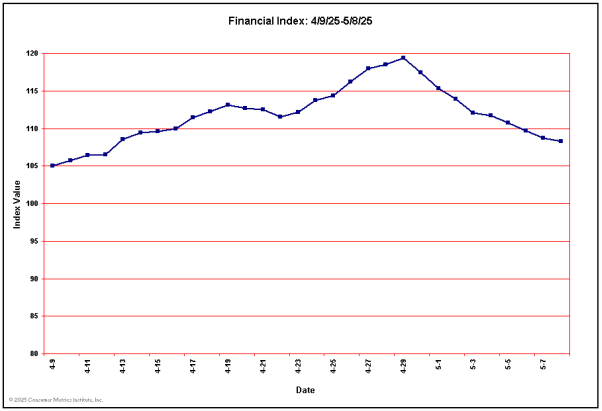
The most notable movement among our sector indexes has been in the Financial Index, which has plummeted from an over 110 (net 10% growth) reading to a net 1% contraction reading of under 99 in just under two weeks (see chart on right below). This movement has corresponded with a general decline in the equity markets, indicating that the investing Consumer may still be hypersensitive to the daily tickers as a result of the past year and a half of financial trauma.
| |